

2025-11-20
THERMAL & VIBRATORY STRESS RELIEF
The commercial welding process subjects metal parts to extremely high temperatures—reaching tens of thousands of degrees Fahrenheit—and while this provides a strong and solid bond, it also creates residual stresses in the material. To prevent cracking, produce stronger joints, and improve dimensional stability in the welded part, stress relief treatment is required.
At Fitchburg Welding, stress relief is accomplished through thermal and vibratory processes, depending on part size, thickness, and metal type. Both methods are highly effective and provide consistent results.
Thermal Stress Relief
The thermal stress relief (TSR) process uses a cycle of heating and cooling to remove residual stress after welding. After the welded part is completely cooled back to room temperature, we place it into a furnace where it can be uniformly heated to a specific temperature, which is then held for a set length of time (depending on part thickness). It is then cooled back to room temperature, slowly enough so that stresses will not redevelop in the material.
Fitchburg Welding’s programmable, surveyed, and calibrated gas-fired oven will meet your stress-relieving needs, both typical and specialized.
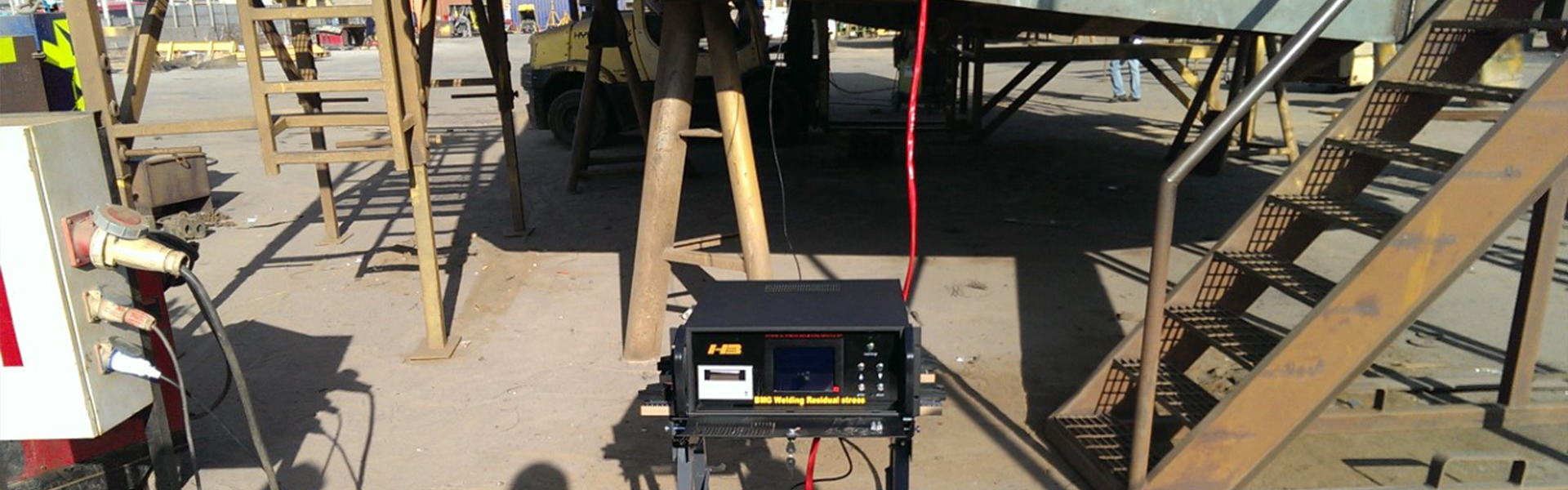
Instead of heat, the vibratory stress relief (VSR) process uses mild, sub-harmonic vibrations to neutralize those post-weld residual stresses. The vibration is maintained for a set period of time (depending on part size), and the welded piece reacts just as it would during heat treatment: the energy is distributed throughout the part, relieving it of stress and stabilizing it.
With skilled operators and semi-automatic VSR equipment, Fitchburg Welding can control each phase of the vibratory stress relief process to ensure the highest quality results.